DPoP is not a claim that every access token should carry a proof. It is a decision to move sender constraint into the application layer when the alternatives do not fit the deployment.
What DPoP buys
A copied access token is no longer sufficient by itself. The resource server can require a proof made with the bound private key, bind that proof to the method, URI, and token, and reject stale or replayed identifiers. The result fits ordinary HTTP and can serve clients that cannot safely hold a traditional client secret or manage a certificate hierarchy.
Those are practical gains, not magic. DPoP does not encrypt the request, prove that the client software is benign, attest a human identity, or protect a private key that an attacker can already use. It narrows one class of replay while leaving other classes of compromise visible.
What DPoP spends
Every participant must agree on more than the access token. The client owns key lifecycle and proof construction; authorization and resource servers own binding and verification; gateways must preserve the relevant headers; operators must account for clocks and replay state; libraries must expose the protocol without hiding its failure modes.
That cost is lower than certificate operations in some systems and higher than bearer-token plumbing in all systems. The correct comparison is not “secure versus insecure,” but “which boundary can this organization operate reliably?”
A final Rust sketch can make the boundary concrete without becoming a reference implementation:
let request = client.get(url).build()?;
let proof = key.proof_for(&request, access_token)?;

request
    .header("Authorization", format!("DPoP {access_token}"))
    .header("DPoP", proof)
    .send()
    .await?;
The code is short because the important design is elsewhere: the same request supplies the method and URI, the key is owned by the client, and the token is presented together with a proof bound to it.
Why this trade can make sense
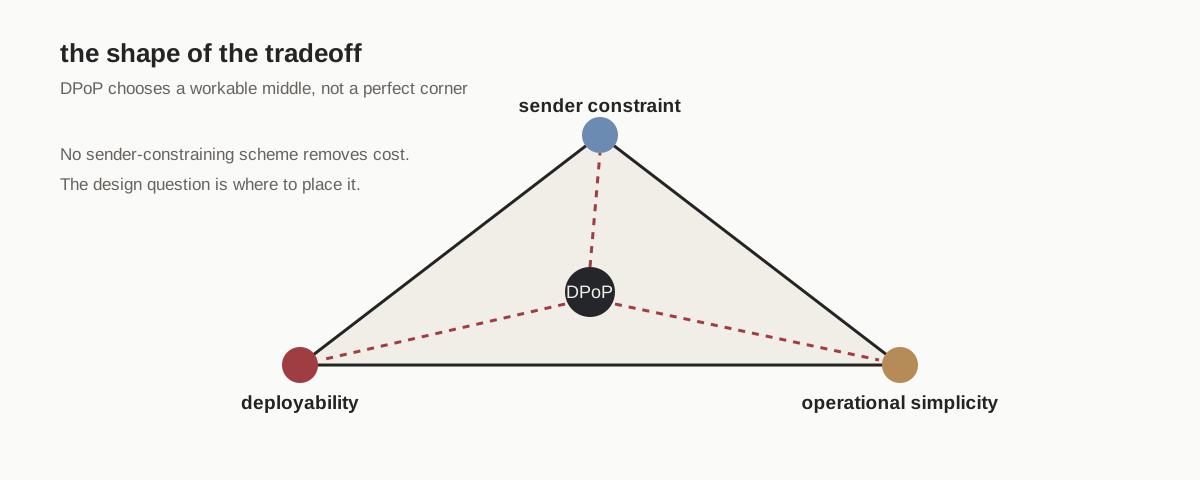
DPoP occupies a middle ground. Bearer tokens offer the easiest interoperability but leave replay entirely to token lifetime and surrounding controls. mTLS offers stronger transport binding but asks a deployment to operate certificates and preserve connection identity. Custom signing can fit a single API exactly but makes each organization responsible for a protocol that others may interpret differently.
DPoP chooses a shared application-layer vocabulary: a key thumbprint, a signed proof, request claims, freshness, and replay detection. That vocabulary does not erase operational work, but it makes the work inspectable and portable across ordinary HTTP paths.
The opening incident now has a different ending. The copied bearer token may still be present in the log, but it no longer carries the private key, the fresh request description, and the unused proof identity needed to pass the resource server's gate.
That is the whole argument for DPoP: not that possession stops mattering, but that possession alone stops being enough.
Comments