DPoP is easier to understand when it is placed beside the designs teams already use. These alternatives are not interchangeable checkboxes: some constrain a token at the transport layer, some at the application layer, and some rely on a platform's protected key store.
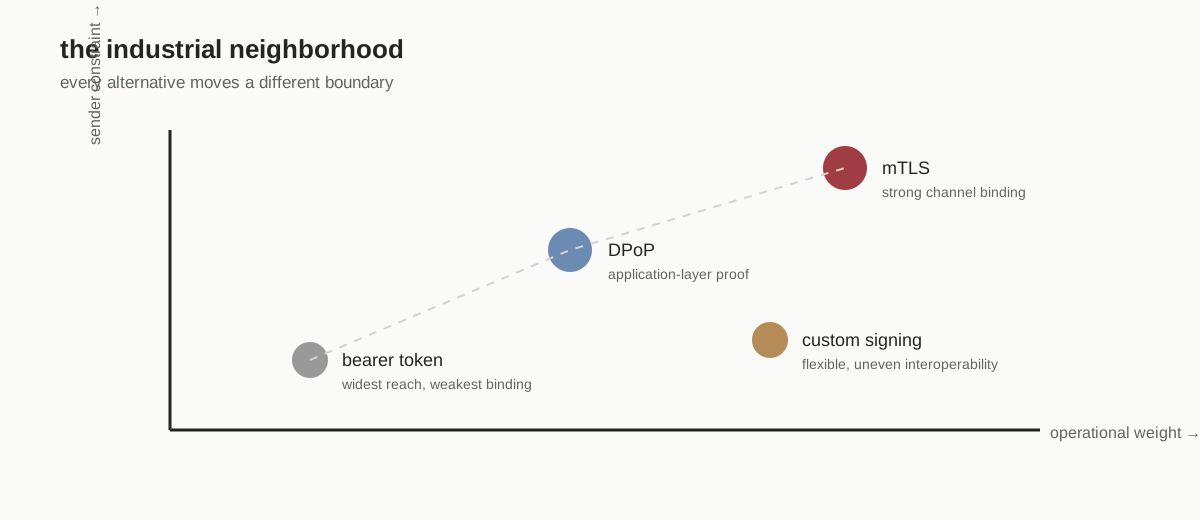
| Approach | Where the binding lives | Advantage | Cost or limitation |
|---|---|---|---|
| Bearer token | Nowhere beyond possession | Broad interoperability and simple clients | A copied token remains usable |
| DPoP | Application-layer proof | Works over ordinary HTTP and suits public clients | Key lifecycle, URI binding, clock, and replay state |
| mTLS | TLS connection and certificate | Strong, mature sender constraint | Certificate provisioning and proxy topology |
| Platform key or attestation | Device or OS boundary | Can protect keys with hardware-backed policy | Platform-specific APIs and uneven server support |
| Custom request signing | Application-defined protocol | Tailored to one API or organization | Interoperability, review, and replay rules become local work |
| Historical Token Binding | Browser transport integration | Attractive original browser model | Did not achieve broad deployment and is obsolete in practice |
mTLS: a strong channel, a heavier operation
Mutual TLS binds a client certificate to the TLS connection. OAuth deployments can issue a certificate-bound access token, and the resource server can compare the certificate presented on the connection with the token's binding.
That is a strong relationship when the topology is under one team's control. It becomes more difficult when mobile apps, browsers, service meshes, API gateways, and TLS-terminating proxies each own a piece of the connection. Certificates need issuance, rotation, secure storage, revocation policy, and a trustworthy way to carry identity across termination points.
DPoP moves the proof into the HTTP request. That makes it more portable across ordinary HTTP infrastructure, but it also means every verifier must implement and operate the protocol correctly.
Platform keys and custom signatures
A mobile platform may keep a private key in a hardware-backed keystore and expose signing without exposing the key. That can strengthen the client boundary, but the resulting API is platform-specific and may prove device or application properties that DPoP itself does not claim to prove.
Custom request-signing schemes can be perfectly reasonable inside one organization. An API may sign a method, path, body digest, timestamp, and nonce with a service key. The difficulty is that the organization now owns the canonicalization rules, key distribution, replay semantics, error vocabulary, and long-term compatibility. DPoP's value is less that its ingredients are novel than that the vocabulary and checks are shared.
Why not choose the strongest-looking option?
A design that is strongest on paper can be unusable at the boundary where a product needs it. Public clients cannot safely keep a traditional client secret, and many deployments cannot preserve one end-to-end TLS connection from app to resource server. A browser-oriented protocol that never reaches browsers is a historical lesson; a bespoke signature that every gateway interprets differently is an operational one.
The fair comparison is therefore conditional. DPoP is attractive when the client can protect a key, the system wants sender-constrained tokens, and ordinary HTTP infrastructure must remain in the path. mTLS is attractive when certificate operations and connection topology are already a strength. Bearer tokens remain reasonable when the threat model accepts replay risk or when the surrounding controls make the token short-lived, narrowly scoped, and easy to revoke.
The next post leaves the comparison table and follows DPoP through its sharpest operational edges.
Comments